
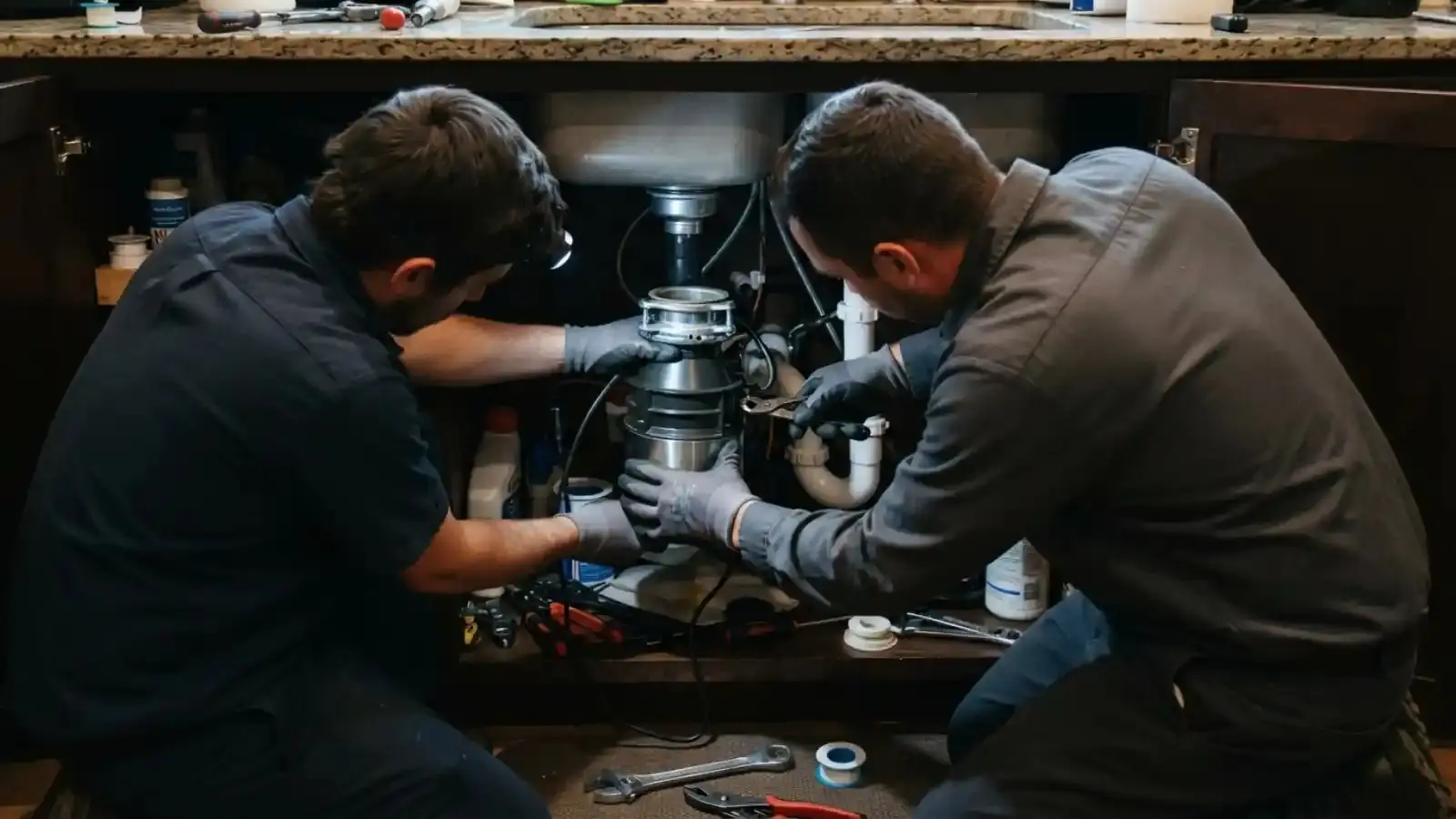
Disposal jammed, flooding the cabinet or dead
A disposal that will not turn, or one that is dripping into the cabinet, is worth a call right away. Our 24/7 dispatch takes these calls, and you can do some safe things before anyone arrives. Turn the disposal switch off, then cut power at the breaker if you plan to look inside.
Never put your hand into the grinding chamber, even when it is switched off. If water is dripping from the unit, put a bowl under it and close the shutoffs under the sink if you have them. Keep the sink unused so nothing else drains through a leaking joint.
- Switch off the disposal and the breaker before any inspection.
- Use tongs or pliers, never fingers, to retrieve an object.
- Do not run hot water or pour chemicals into a jammed unit.
- If water pools near outlets, turn off power to that area.
Safety steps before you call
Disposal trouble mixes water, power and moving parts, so a few steps come first.
- Switch the disposal off at the wall and also at the breaker before anything goes near the drain.
- Never put a hand in the chamber. Use tongs or pliers for anything you can see.
- Do not touch the unit, the switch or the cord if water is standing around them.
- Turn off the water under the sink if the cabinet is filling.
- If you smell gas, leave the house and call the gas utility or 911.
Disposal humming, stuck or dripping? Call and we will talk you through it.
(732) 466-1098Humming, stuck or silent
| Sound | Likely cause | What to try |
|---|---|---|
| Hum, no spin | Jammed flywheel | Hex wrench in the bottom socket, with power off |
| Click or nothing | Tripped overload | Press the red reset button on the bottom |
| Dead and no reset | Power or switch fault | Check the breaker, then call |
| Grinding or rattle | Foreign object | Remove with tongs, power off |
The reset button sits on the underside of the unit. If it pops back out right away, stop and call. Forcing the motor repeatedly can burn it out.
Freeing a jam step by step
- Power offSwitch it off at the wall and at the breaker.
- Find the socketLook under the unit for a small hex socket in the center.
- Turn the wrenchWork it back and forth until the flywheel moves freely.
- Pull the causeUse tongs to lift out the object you can see from the sink.
- Reset and testPress the reset, restore power and run cold water as you test.
Leaks at the flange, the unit or the drain line
Where the water appears tells you where the leak is. A drip from the sink rim points to the flange seal. Water from the side of the body usually means a failed seal inside the unit or a loose hose. Wetness at the bottom means a cracked housing, which is not repairable.
A leak that runs at the dishwasher hose or the drain trap is often a loose clamp. If you can see one, see how a drain clog behaves when water backs up the dishwasher line.
Clogs that look like disposal trouble
Sometimes the unit grinds fine but the sink stays full. That is a drain issue below the disposal, often grease and food scraps packed into the trap or the line beyond it. A cable or a camera finds it.
Repeated clogs mean there is more to the story than one stuck fork. See drain cleaning for how we approach a line that keeps closing.
When replacement is the better call
A seized motor, a cracked housing or a unit with a leaking body is usually cheaper to replace than to repair. When we replace one, we match the mounting, check the power and confirm the dishwasher knockout is opened if a dishwasher hooks in. If you need new wiring or plumbing, we can handle it as part of plumbing installation.
Choosing a replacement unit
Swapping a disposal for a similar unit with no change to the piping is ordinary maintenance that needs no permit or inspection, according to the state Department of Community Affairs code alert. The new unit still has to meet code.
Horsepower
A larger motor handles tougher scraps and runs quieter, but it costs more.
Mounting
The mounting style must match your sink flange or the old one will not fit.
Dishwasher connection
If a dishwasher drains through it, the knockout plug inside must be removed.
Power
A plug or hardwired connection decides the electrical work needed.
Source: NJ Department of Community Affairs code alert on 2018 NJ Register changes, nj.gov/dca/codes/alerts/pdfs/OM_MW_03052018.pdf
What should never go down the disposal
Grease and cooking oil harden in the drain beyond the unit. Fibrous foods like celery, corn husks and artichoke leaves wrap the blades. Coffee grounds and eggshells pack together in the trap.
Bones, fruit pits and metal can jam it outright. Run cold water while you grind and for a few seconds after, so the scraps clear the line.
What affects the price
Homeowners policies often cover sudden water damage from a failed fitting but not wear on the unit, so ask your insurer. We give a clear price before work starts, and a real number is available by phone once you describe the problem.
Same-day and after-hours calls near you
Same-day appointments are offered when available, and after-hours dispatch handles active leaks. We serve North Brunswick and Piscataway as well as New Brunswick.
Frequently asked questions
Yes. Dispatch is open 24/7 for disposals that leak or jam. Call, say what you see, and we will advise on safe steps while a crew is arranged.
The flywheel is usually jammed. With power off, turn the hex socket at the bottom of the unit back and forth to free it.
It is a small red button on the bottom of the unit. Press it once after the motor cools.
No. Use tongs or pliers with the power off at the breaker.
A loose flange or hose often can. A leak from the body or a cracked housing means replacing the unit.
Typically a short visit once we have the right unit. We confirm the mounting and power before starting.
Ask the New Brunswick building department, since rules depend on the work involved.