The toilet is overflowing or flooding the floor
Act first, then call. Our line at (732) 466-1098 runs 24/7. Reach behind the toilet and turn the small oval-handled valve clockwise until it stops. That cuts the refill and usually ends the overflow.
If the bowl is still rising, lift the tank lid and push the flapper down to block the tank from emptying into the bowl. Stay out of any water that touches outlets or a power strip.
- Do not flush again to see if it clears. Every flush adds water to a blocked bowl.
- Put towels down and keep children and pets out of the bathroom.
- If the valve behind the toilet is stuck, close the main water shutoff for the home.
- If sewage is backing up in a tub or floor drain too, the problem is deeper than the toilet. Say so on the call.
Toilet runs, hisses or will not stay filled
Flapper that does not seal
The rubber disc at the bottom of the tank hardens or warps. Water leaks past it into the bowl and the tank refills every few minutes.
Fill valve that will not shut off
If water keeps flowing into the overflow tube, the fill valve is worn or the float is set too high.
Chain too tight or too slack
A chain with no slack holds the flapper open. Too much slack gives a weak flush.
Handle that sticks
A bent arm or a loose nut means you jiggle the handle to stop it running.
A running toilet wastes water around the clock and shows up on your bill. If you can hear it when nothing is flushing, it is worth fixing soon.
Bowl rising or floor wet? Close the valve behind the toilet, then call us.
(732) 466-1098Leaking around the base
Water at the base can come from three places. A tired wax ring under the bowl, a loose or corroded closet flange in the floor, or sweating on the tank that drips down the outside. A towel test tells you which. Dry everything, wrap tissue around the base and tank bolts, and see where it wets first.
A wax ring leak is slow and can rot the subfloor before you see a stain. If the floor feels soft near the toilet, stop using it and call. Wet flooring may also need a look from leak detection if the source is not obvious.
Clogged or backing up
| Symptom | Likely cause | What to try |
|---|---|---|
| Bowl fills slowly, drains slowly | Partial clog in the trap | A flange plunger, steady strokes |
| Gurgling and a second fixture drains slowly | Blockage further down the branch line | Stop using the fixture, call |
| Water rises in tub when you flush | Main drain blockage | Do not flush, call right away |
| Repeated clogs after a flush | Toy, wipe or buildup in the trap or weak flush | Call for a camera check or removal |
If plunging does not clear it in a few minutes, the clog is likely beyond the bowl. See drain cleaning for how a blockage in the line is cleared.
Rocking, wobbly or sweating toilets
A toilet that moves when you sit on it has loose floor bolts or a failing seal. Do not crank the bolts hard, because porcelain cracks. A plumber can reset the toilet, replace the wax ring and check the flange while it is up.
Tank condensation on humid days is not a leak, but it can make the floor slippery. Insulated tank liners or a mixing valve are fixes people ask about.
When to replace instead of repair
If the bowl or tank has a hairline crack, replacement is the answer. Frequent clogs from a weak flush, constant parts failures, or a toilet that cannot handle normal use are other signs. A new unit also lets you choose a taller bowl or a model that flushes with less water.
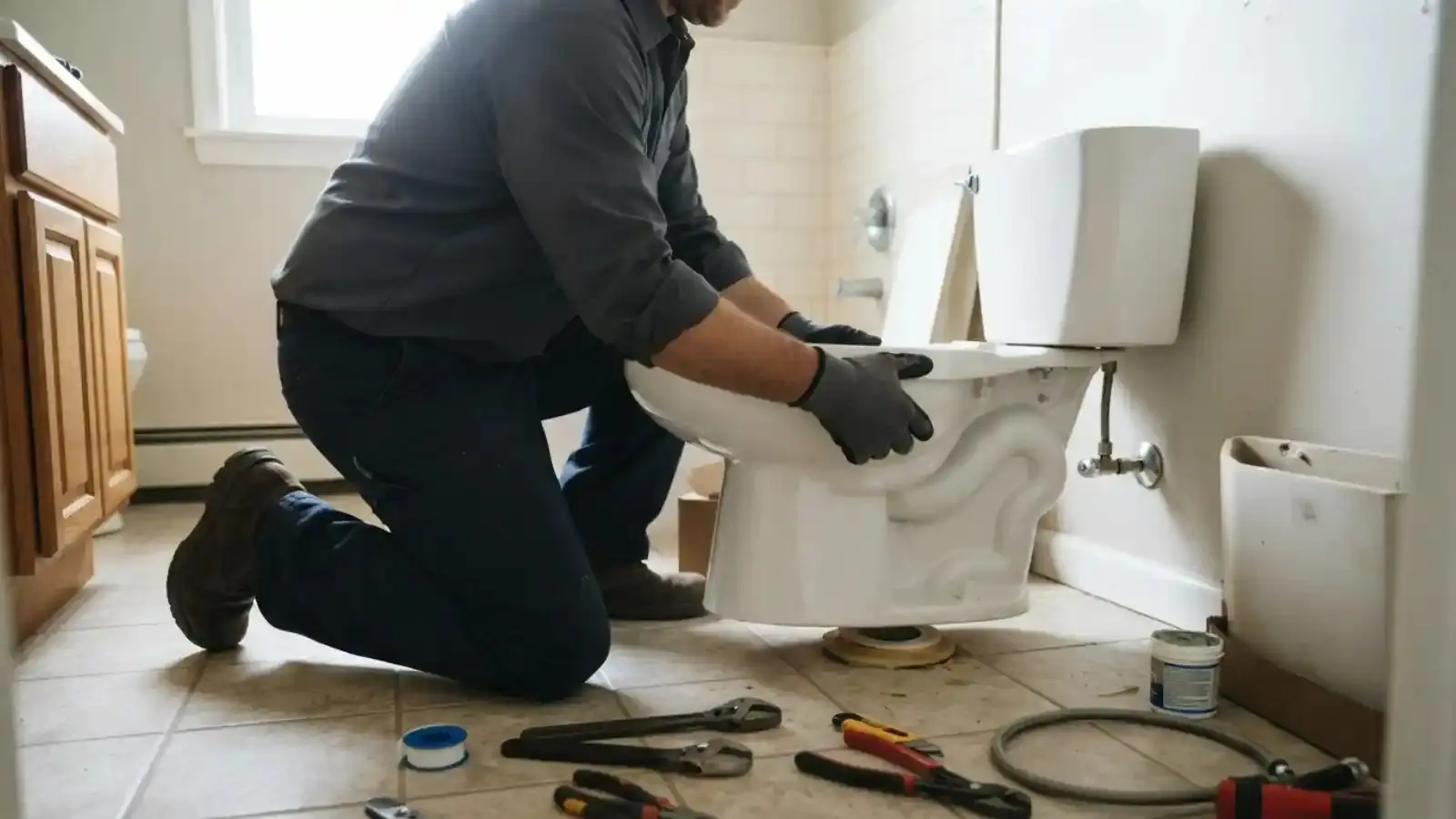
A swap takes less time than most people expect, and it falls under plumbing installation work. The plumber checks the supply line, valve and flange at the same time.
According to the state Department of Community Affairs code alert, swapping a fixture for a similar one with no change in piping is ordinary maintenance with no permit or inspection, though it must still meet code. Adding a new fixture is different and counts as minor work that needs a permit.
Source: NJ Department of Community Affairs code alert on 2018 changes to minor work and ordinary maintenance, nj.gov/dca/codes/alerts/pdfs/OM_MW_03052018.pdf
Apartments, rentals and shared stacks
We do not have a sourced renter share for New Brunswick, so we will not guess at housing mix. The practical point holds anywhere with shared walls. A toilet overflow can drip through to the unit below, and a blocked stack can back up into other homes.
If you rent, tell your landlord or property manager right away and take photos. If you are in Piscataway, see our page on plumbing service in Piscataway.
What sets the price of a toilet repair
Homeowners policies often cover sudden water damage but not wear on the fixture itself, so ask your insurer before you assume.
We give a clear price before work starts. For a real number, call (732) 466-1098 and describe the toilet.
Frequently asked questions
Yes. Dispatch runs 24/7, and we offer same-day appointments when available, including after-hours and weekend calls. Tell us if water is on the floor or the bowl is still rising.
Close the valve behind the toilet while you wait.
It is a small valve on the wall or floor behind the toilet, where the supply line enters. Turn it clockwise. If it will not turn, close the main water shutoff instead.
Most often the flapper is not sealing or the fill valve is not shutting off. Check that the chain has a little slack. If water trickles into the overflow tube, the fill valve needs work.
It can be. A failing wax ring lets water reach the subfloor out of sight. If the floor feels spongy or the toilet rocks, stop using it.
We advise against it. The chemical can sit in the bowl and splash a plumber, and it can damage some fittings. A plunger is the safe first step.
Repair suits a running tank or a worn seal. Replace if the porcelain is cracked or the toilet clogs constantly. The plumber can say which makes sense once it is open.
Yes, a clear price before work starts. Call (732) 466-1098 for a real number on your toilet.