
Water is actively leaking right now
If water is dripping from a ceiling, spreading across a floor or running somewhere you cannot see, act first and diagnose later. Dispatch answers 24/7, and while you wait the most useful thing you can do is close the main water valve by turning it clockwise until it stops.
Then open one low faucet to drain the pipes. If water is near outlets, light fixtures or appliances, switch off the breaker for that area and stay out of any standing water. Never touch electrical items while standing in water. A gas smell means leave and call the gas utility or 911 first.
- Locate the main shutoff before you need it.
- Move valuables and rugs out of the wet zone.
- Put a bucket under ceiling drips.
- Take photos of the damage for your insurer.
Reading the signs of a hidden leak
| What you notice | Common cause | First check |
|---|---|---|
| Water bill rises with no change in habits | Running toilet or hidden line leak | Meter test below |
| Stain spreading on a ceiling | Supply or drain line above, or roof | Is it wet only after rain? |
| Warm patch on the floor | Hot line leaking under the floor | Check floor above a water heater line |
| Low pressure at every tap | Leak on the service line | Look at the yard and meter box |
| Musty smell, no visible water | Slow leak inside a wall | Moisture reading |
Many calls turn out to be rain, condensation or a worn flapper, so sorting those out first saves time.
Not sure whether it is a leak? Call and describe what you see. We will tell you what to check.
(732) 466-1098Meter still running or a high water bill
The water meter is the quickest honest test for a leak you cannot see. Turn off every tap, appliance and ice maker in the house. Then look at the meter. Many meters have a small low-flow indicator, often a dial or triangle, that spins when any water moves through.
If it keeps moving with everything off, water is going somewhere. Close the main valve inside the house and look again. If the meter stops, the leak is inside the building. If it keeps moving, the leak is on the buried line between the meter and the house, and water line repair may be the next step.
Meter designs vary, so ask your water utility how to read yours. Toilets are a common cause of a quiet bill rise. Food coloring in the tank shows it if color reaches the bowl without flushing.
Wet ceiling or wall
A ceiling stain can come from a supply line, a drain, a roof or condensation, and those need different fixes. If the stain grows even when no water is running upstairs, suspect the roof or a pressurised line. If it grows after a shower or flush, suspect a drain or a tub seal.
We use a moisture meter and, where useful, a thermal camera to map how far water has spread before cutting anything. If the answer is the roof or exterior, we say so and point you to the right trade.
Slab, crawlspace and under-floor leaks
Leaks under a concrete floor or in a crawlspace show up as hot spots, a constant sound of running water, or a wet patch with no source above. We do not assume how your home is built. Foundations vary, so we check each one.
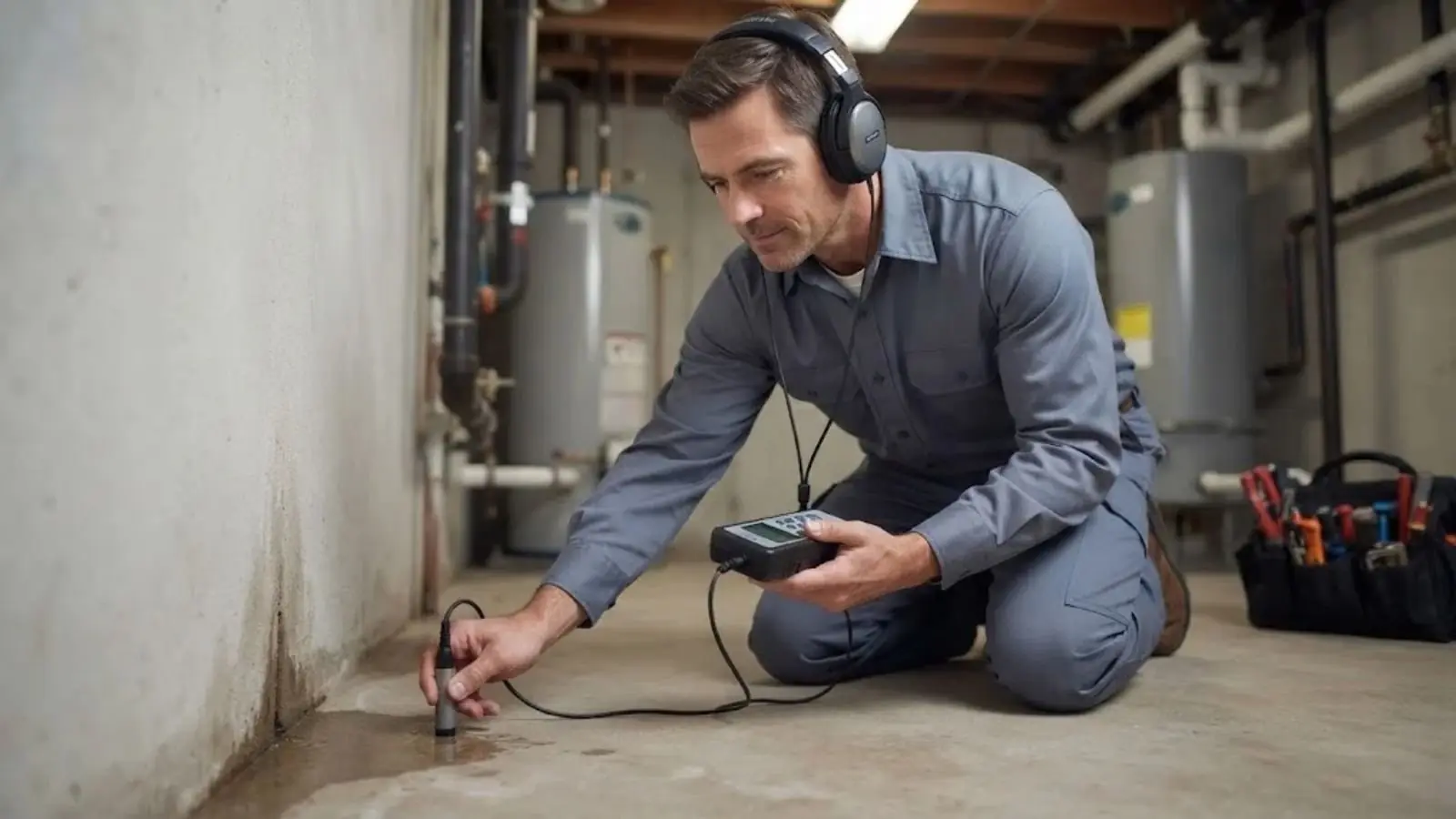
Acoustic listening gear picks up the hiss of pressurised water through concrete. Tracer gas, a harmless mix pushed into an emptied line, can confirm the location when sound is unclear. Only then do we talk about breaking the floor or rerouting the line.
A leak in the yard or between meter and house
Soft ground, a patch of grass that stays green or a sinkhole forming near the line are signs of a buried leak. So is low pressure all through the house. Water may travel along the pipe trench before it surfaces, so the wet spot is not always above the break.
Acoustic detection traces the pipe and finds where the leak noise is loudest, which keeps digging small.
This describes New Jersey American Water service areas, so check your own utility. According to New Jersey American Water, the company maintains the service line from the main to the curb stop, and the customer maintains the pipe from the curb stop to the building. A leak past the curb is generally the homeowner's repair, and the curb stop itself should be left to the utility.
Source: New Jersey American Water, customer rights and responsibilities, amwater.com/njaw/customer-service-billing/rights-responsibilities (New Jersey American Water service areas only)
Methods we use to find the source
Acoustic listening
Sensitive microphones on pipes, floors and valves pick up the sound of escaping water.
Thermal imaging
Shows temperature differences from hot lines or wet material behind surfaces.
Moisture meters
Map how far water has moved into drywall, wood and subfloor.
Tracer gas
Pinpoints leaks in pipes that give little sound, such as plastic or deep lines.
Local water and where leaks start
Highland Park's water operator offers a service line material verification test, so a homeowner there can learn what their incoming pipe is made of. If your leak is on the buried line, knowing the material helps decide between a patch and a replacement, and the same question is worth asking your own utility. Customers in Highland Park can start with that operator.
Homes in Piscataway, delivery ZIP 08854, should ask their own water supplier for any service line records.
Source: Middlesex Water, Utility Service Affiliates, Highland Park page.
Businesses and multi-unit buildings
A leak in a shop or an apartment building often involves several tenants and a shared riser, so finding the source also means finding which unit it comes from. We trace it with the same tools, then hand the owner a written location.
What affects the price of leak detection
Homeowners policies often cover sudden pipe failure but not wear, and some policies cover the cost of finding a leak while others do not. Ask your insurer.
Call and we will give you a real number by phone, with a clear price before work starts. Same-day appointments are available when the schedule allows.
Frequently asked questions
Yes. Dispatch is open 24/7. If water is running somewhere it should not, close the main valve first and then call. We will talk you through what to switch off.
Signs are a rising bill, a meter that moves with everything off, damp smells, stains and low pressure. The meter test on this page is the simplest first step.
Often not at first. We map the damp area and listen for the leak before cutting. If an opening is needed, we keep it as small as the repair allows.
Yes, with acoustic gear and sometimes tracer gas. Results depend on the pipe material and how deep the line sits.
Close the main valve in the house and watch the meter. If it stops, the leak is inside. If it keeps moving, it is on the buried line.
They are separate steps. Once we find it, you get the repair options and a clear price before work starts.
Call the utility if the leak is on their side of the meter. Call us for anything on the house side, and if you are unsure, call us and we will help you work out which.