
Backed up right now and need a jetting crew
A line that has stopped taking water is urgent, and our dispatch runs 24/7 for exactly this. While you wait, stop running water in the house, since every flush and rinse adds to what is already sitting in the pipe. If the lowest drain in the building is gurgling or rising, keep people and pets away from it.
Do not pour chemical drain openers into a line that is full. They sit in the standing water, can burn skin, and make the job harder for whoever has to work on the pipe. If sewage is coming up near the electrical panel, a furnace or a water heater, shut off power to that area only if you can reach the switch without stepping in water.
- Stop using sinks, showers, dishwashers and washing machines.
- Locate the main water shutoff in case a fixture overflows.
- Never touch electrical items while standing in water.
- Note which drains are affected, because it helps the dispatcher judge where the blockage sits.
What a jetter actually does inside the pipe
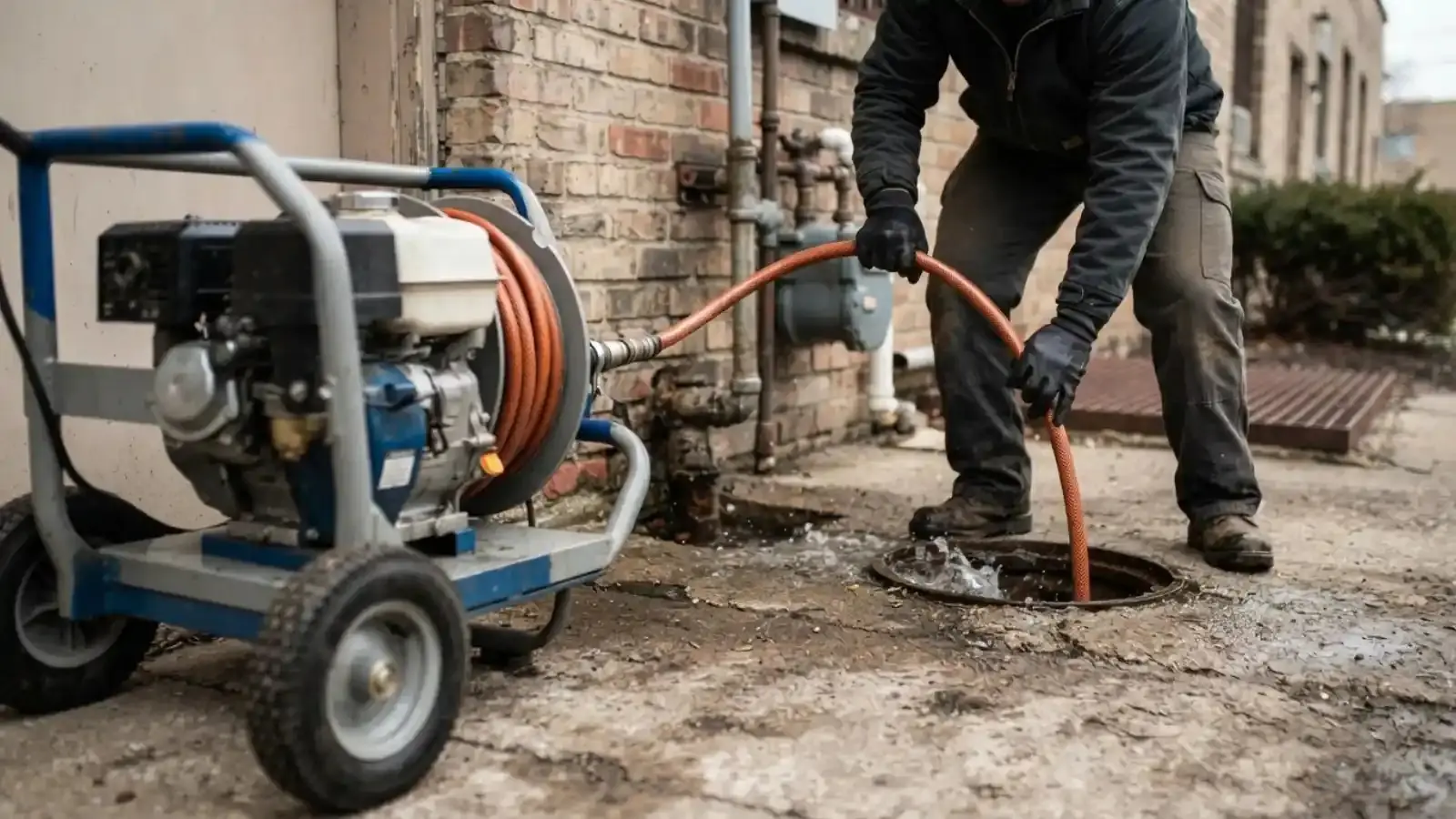
A hydro jetter pumps water through a hose to a nozzle with several small orifices. Some jets point backward and pull the hose forward, others angle outward and strip the pipe wall. The result is a scrubbed line, not a tunnel through the clog.
That difference is why the method suits grease rings, soap scum and mineral scale. A cable head spins through the center and leaves a coating on the walls, and the next wave of debris catches on it. Water pressure takes the coating with it and flushes the loosened material down to the sewer.
Nozzle choice matters
Plumbers pick a nozzle for the job. A forward-facing tip opens a line that is almost shut. A wide fan tip cleans the walls of a line that is already moving. Roots call for a cutting head, used carefully, and a different pressure setting than grease.
Repeat blockage or a backed-up line? Call and describe it to a dispatcher.
(732) 466-1098Grease, scale and roots: which one you have
| Cause | What you notice | How jetting helps |
|---|---|---|
| Grease and soap build-up | Kitchen line slows, smells, clears then returns | Strips the film off the pipe wall |
| Mineral scale | Slow drains in older iron or galvanized lines | Breaks loose flaking deposits, though thick scale may need other work |
| Tree roots | Gurgling toilets, backups in the lowest drain | A cutting nozzle clears the fibers, but roots regrow if the joint stays open |
| Packed debris | Sudden full stoppage | Pressure drives the mass toward the main |
Many of these look the same from the sink. A camera look tells you which one you have, which is why we suggest it before any pressure goes into an unknown pipe.
Why we look with a camera before we jet
Water at jetting pressure can do damage to a pipe that is already cracked, offset or collapsed. Pushing it through a failing section can enlarge a break or wash soil into the line. A short camera run shows the pipe condition first, so the plan fits the pipe.
If the picture shows a belly, a crushed section or a joint that has slipped apart, jetting will not fix it. Those findings point toward sewer line repair rather than another cleaning. We would rather tell you that before spending your money on water.
When a cable is enough and when jetting is the better call
A single slow sink with no history is often a cable job. See drain cleaning for that. Jetting earns its place when a line has been cleared more than once and still fills, when grease is the known cause, or when a main line serves several fixtures and has slowed down.
Steps on the job
- Phone triageYou describe the symptoms and we ask which drains are affected and how long it has been happening.
- Access the lineWe find a cleanout or pull a fixture to get the hose into the pipe.
- Camera lookWe check the pipe condition and mark anything that rules out pressure.
- Jet the lineWater pressure scrubs the walls from the far end back toward the access point.
- Confirm flowWe run water and, where useful, look again to see the wall is clean.
Commercial kitchens and repeat grease lines
Restaurants and food service kitchens put heavy grease through small lines every day. Scheduled jetting often costs less than repeated after-hours backups, because the pipe never gets the chance to narrow.
Ask the building department and your landlord or lease about grease trap and cleaning requirements for your space, since we cannot state those rules from memory. For a general look at business work, see commercial plumbing.
According to the New Jersey Division of Consumer Affairs plumbing board, plumbing work in the state must be performed by a master plumber or authorized plumbing contractor. Before anyone opens a cleanout or cuts into a grease line, it is fair to ask who is licensed to do the job.
Source: NJ Division of Consumer Affairs, State Board of Examiners of Master Plumbers FAQ, njconsumeraffairs.gov/plu/Pages/FAQ.aspx
What affects the price
Homeowners policies often cover sudden damage but not wear or a gradual blockage, so ask your insurer before assuming. We give a clear price before work starts, and you can get a real number by phone after describing the problem.
Local water and drain notes
North Brunswick publishes a water quality report that lists hardness of 67.5 ppm as calcium carbonate for 2022, which is on the softer side. Scale deposits in drains build more slowly in softer water, so grease and roots are more likely culprits in a repeat blockage there than heavy scale. For homes in East Brunswick or elsewhere, ask your own water utility for its annual report.
Source: North Brunswick Township water quality report, 2022 data
Frequently asked questions
Yes. Dispatch is open around the clock. Call, describe which drains are backed up, and we will tell you if a same-day or after-hours visit fits your situation.
Until the crew arrives, stop using water and keep away from standing sewage.
A cable pushes a spinning head through the middle of a clog. A jetter uses water pressure to scour the whole pipe wall. Jetting is the better pick for grease and scale, while a cable often suits a simple stoppage.
On sound pipe at the right pressure, no. On cracked or collapsed pipe it can make things worse, which is why we use a camera first and adjust pressure to the pipe.
A cutting nozzle can clear roots from the pipe. Roots usually return if they entered through a bad joint, so a camera look helps decide on a longer-term fix.
If the line clears and then clogs again within weeks, grease or roots are likely. If the camera shows a sag or break, you need a repair. Water pressure does not straighten a pipe.
It depends on the pipe condition, which is why we look first. Brittle or heavily scaled pipe may need lower pressure or a different method.
We give a clear price before work starts, based on access, line length and what the camera shows. Call for a real number.
Permit rules are set by the municipality, so ask the New Brunswick building department whether your job needs one.