
Before the first pipe is cut
Installation is a planned job, so the best time to call is early, while walls are still open on paper. Tell us which rooms are changing, what fixtures you have picked and where the existing stack, main and water lines run. A short phone call is enough to start, and we explain the scope and give a clear price before work starts.
Licensed and insured, we serve New Brunswick and nearby towns. If the job needs a permit, we help you understand what to ask for. The permit question is below, in plain terms.
What we install
Bathrooms
Toilets, vanities, tubs, showers and valves, whether it is a swap or a bathroom in a space that never had one.
Kitchens and laundry
Sinks, dishwasher and ice maker supplies, washer boxes and the drains behind them.
Additions and new construction
Supply and drain runs for a new wing, a second story or a detached space.
Utility work
Hose bibs, utility sinks, shutoff valves and a stub for future fixtures.
Planning a remodel or addition? Call and we will talk through the scope and the price before anything starts.
(732) 466-1098Rough-in and finish
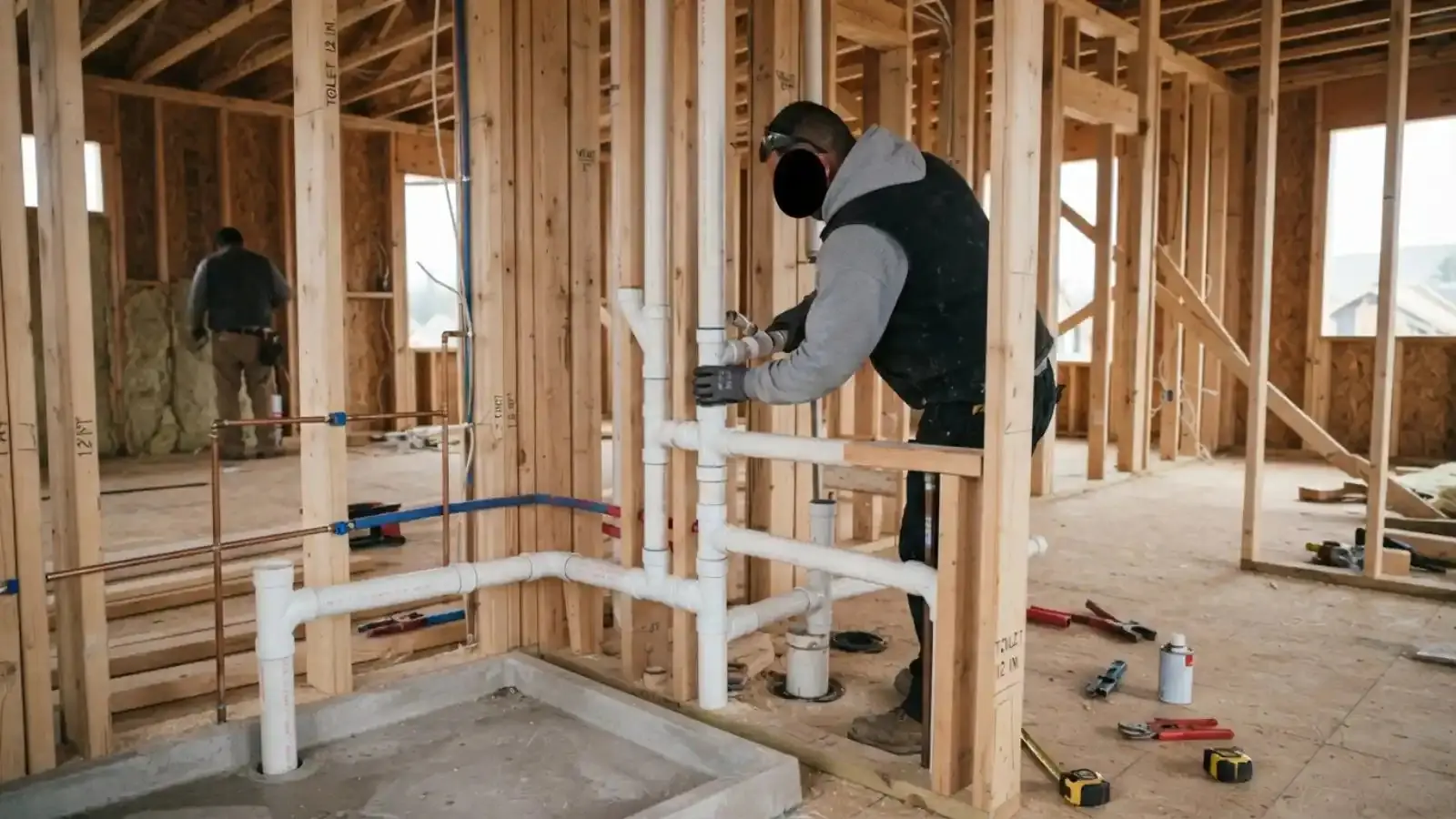
- Plan and layoutWe confirm fixture locations, wall depth, venting and where drains need to fall.
- Rough-inPipes are set inside open walls and floors before drywall. Drain slope and vent paths are fixed here.
- Inspection stageIf your job needs one, inspection happens with the pipes still visible. Leave walls open until it passes.
- Close up and finishAfter walls are closed, we set the fixtures, connect the valves and test for leaks.
- WalkthroughWe show you the shutoff valves and how to use them.
Basement bathrooms
Below-grade rooms need extra planning because drains cannot fall to a sewer that sits higher than the floor. Often the answer is a sewage ejector, a sealed basin with a pump that lifts waste up to the main drain. It needs a vent, a check valve and a power supply that stays on.
A concrete floor must be cut to bring drains in. Plan for the dust and for the time to cure patch concrete before tile goes down. A sump pit is not an ejector pit, and mixing them up causes trouble. If groundwater is already a worry, see basement waterproofing first.
Permits and inspections
New plumbing or a change to existing drains and vents often falls under a permit, but we will not state rules we cannot source. Ask the New Brunswick building department what your project needs and whether a licensed plumber must pull the permit.
Tell us if the permit is already in hand when you call. Keep the inspection sign-off with your house records, because buyers and insurers sometimes ask for it later.
According to the state Department of Community Affairs code alert, installing additional new fixtures in an existing space is minor work in dwellings when the water distribution system does not grow in size. A like-for-like swap with no piping change needs no permit, so the line between the two matters.
Source: NJ Department of Community Affairs code alert on 2018 Uniform Construction Code changes, nj.gov/dca/codes/alerts/pdfs/OM_MW_03052018.pdf
Fitting new work into an old house
Walls in older homes can hide old galvanized or cast-iron pipes. New fixtures on tired pipe can show low pressure fast, because the old line has narrowed inside. We check what you have before tying in, and we say when repiping part of the house is the saner option.
If you want to see how that decision plays out, read about repiping. A new bathroom on a failing line is money spent twice.
Edison and East Brunswick projects
Our reach includes Edison, with ZIPs including 08817 and 08820, and East Brunswick, ZIP 08816. Both are close to New Brunswick, so the same crew can often cover a job across the town line.
Permit offices differ from town to town, so check with the building department in the town where the work will be done. The Edison page and the East Brunswick page have more on those areas.
Source: Python zipcodes package listings for ZIP 08817, 08820 and 08816
What drives the price of an install
Homeowners insurance generally does not pay for new work you choose to add. It may cover resulting damage if a new connection fails suddenly, so ask your insurer how your policy treats this.
We give a real number by phone once we know the rooms, the fixtures and the access. Call (732) 466-1098.
What to have ready
- Fixture model numbers or a clear photo of what you chose.
- A sketch of the room, even rough, with sizes.
- Where the main shutoff and the floor drain are.
- Permit details or the name of the contact you spoke to.
- Photos of any pipes you can see in the basement or crawl space.
Frequently asked questions
It depends on the work. Moving or adding drains, vents and supply lines often needs one, and simple like-for-like swaps may not. Ask the New Brunswick building department what your job requires, and tell us what they say.
We give a clear price before work starts. After a phone call about scope, fixtures and access, we give a real number by phone. If scope changes, we say so before extra work begins.
Often yes, but it depends on where your main drain sits. If it is higher than the floor, an ejector pump system is the usual answer. We look at the layout and explain the options.
Rough-in is the pipework inside walls and floors before they are closed. Finish is setting fixtures and connecting them once the room is ready.
Usually, yes. Share the model numbers first, so we can check the rough-in size and connection type. Some fixtures need specific valves.
We offer same-day appointments when available for planning calls. Larger jobs are scheduled around your remodel timeline.
If the pipes are galvanized, badly scaled or leaking, yes, it is wise to look at them first. We assess what you have and tell you what is sensible.