
Signs your supply pipes are near the end
Repiping is a planned job, and the best time to decide is before a pipe opens up inside a wall. The usual warning signs are rusty or brown water after the house has been idle, pressure that has faded fixture by fixture, and pinhole leaks that keep showing up in different places.
One leak on its own does not mean the whole system is finished. Several in a short stretch, especially on the same material, usually does.
- Brown or yellow water when you first open a tap.
- Pressure that is weak at every fixture rather than at a single tap.
- Green crust or pinhole beads of water on exposed pipe.
- Repeated repairs on the same line, or stains spreading on ceilings and walls.
Pipe materials compared
| Material | How it fails | Notes |
|---|---|---|
| Galvanized steel | Rusts from the inside, narrows, drops pressure | Replacement is common once flow drops |
| Copper | Pinholes, joint leaks, thinning elbows | Often repairable, not always worth patching |
| CPVC | Becomes brittle, cracks at fittings | Plastic that has aged or seen heat |
| PEX | Rare failures, mostly at fittings | A common replacement choice |
| Lead | Not a leak problem, a health one | Have the material confirmed and replaced |
A technician identifies the material on site, since pipe color and age alone can mislead. If you suspect lead, do not wait for a leak. Ask your water utility how to verify the material of your service line.
Not sure repiping is the answer? Call and we will tell you honestly whether a repair would do.
(732) 466-1098Whole house or one section at a time
Whole-house pipe work is plumbing, and according to the New Jersey plumbing board it is reserved for licensed master plumbers and authorized contractors, so ask who is responsible before any wall is opened.
Whole house
Best when the material is the same throughout and symptoms appear at many fixtures. One set of walls is opened, and you do not live through the job twice.
Phased
Best when the budget or the house layout calls for it. Start with the worst riser or the kitchen and bath, then continue later.
Targeted replacement
Best when one run has failed and the rest tests sound. See pinpointing the leak first before opening any walls.
Source: NJ Division of Consumer Affairs, State Board of Examiners of Master Plumbers FAQ, njconsumeraffairs.gov/plu/Pages/FAQ.aspx
What the work involves
Under the State Board of Examiners of Master Plumbers FAQ, plumbing work in New Jersey may only be done by a master plumber or an authorized plumbing contractor. For a repipe, that is the question to settle before anyone opens a wall.
- Walk-through and planWe look at the main shutoff, the meter, the pipe runs you can see and the layout, then talk through which walls need access.
- Price and permit checkYou receive a clear price before work starts. Ask the building department whether a permit and inspection apply to your job, and we will work with whatever they require.
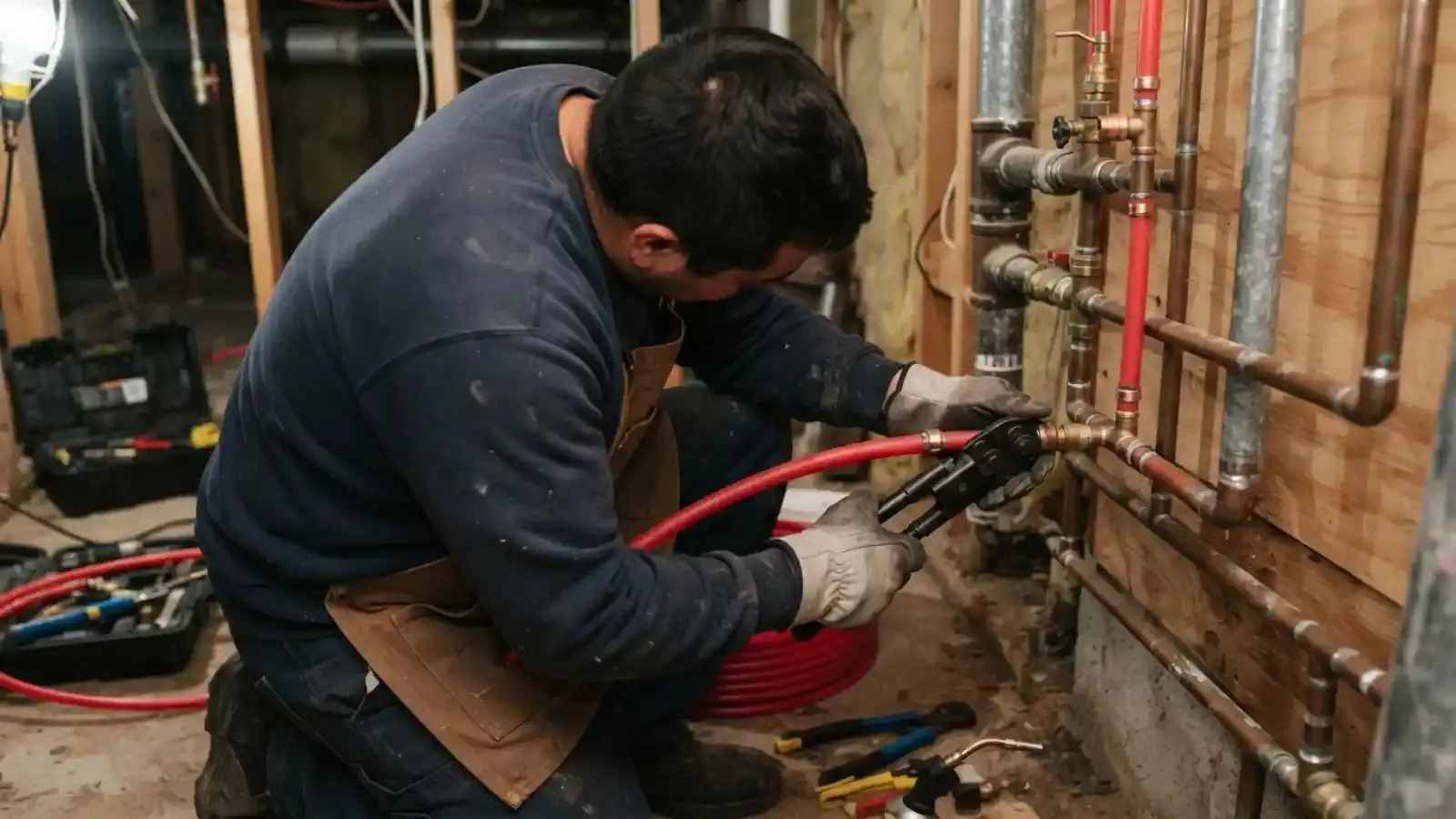
- Water off and rough-inThe water is shut off for planned hours. Old lines are cut out and new lines are run, usually through basements, closets and open framing where possible.
- Drywall accessSome walls need openings. We keep them as small as practical, and patching or painting is a separate trade unless agreed otherwise.
- Pressure test and restartNew lines are pressure tested before walls close, then water is turned back on and fixtures are checked for flow and leaks.
Source: NJ Division of Consumer Affairs, State Board of Examiners of Master Plumbers FAQ, njconsumeraffairs.gov/plu/Pages/FAQ.aspx
Why water chemistry matters for old pipe
Slightly acidic water can be harder on metal pipe over time. The 2022 water quality report for the North Brunswick township utility lists a pH of 6.41 against a recommended range of 6.5 to 8.5, which is one reason pipe condition is worth checking in older homes there.
Water supply differs from town to town, including between New Brunswick, North Brunswick and its neighbors. Ask your own water utility for its annual water quality report, and compare the pH to the pipe symptoms you are seeing.
Source: Township of North Brunswick 2022 water quality report
Copper, CPVC and mixed systems
Copper that leaks in one spot can often be repaired, but a house with thin-walled elbows and multiple pinholes is a different case. We look at where the leaks are, how old the system seems, and what the failed section looked like.
CPVC tends to show trouble at fittings and where it was run close to hot equipment. Homes sometimes have a mix of materials after past repairs, which makes it worth replacing the weakest sections first. If a pipe fails before you decide, our burst pipe repair page explains what to do.
What drives the price of a repipe
Homeowners insurance often covers sudden pipe failure and the resulting damage, but usually not wear and corrosion, so ask your insurer how your policy treats it. Call (732) 466-1098 and we will give you a real number once we know your house. Related work like new fixtures sits under plumbing installation.
Frequently asked questions
Look at the pattern. One leak on an otherwise sound system is a repair. Several leaks, low pressure at every tap and discolored water point to a system near the end. A technician can test and tell you which side your house is on.
It depends on house size, but expect planned shutoffs over the course of the job. We will tell you ahead of time when the water will be off so you can plan.
Ask the building department. Rules for replacement plumbing vary and we do not guess at them. We can work with whatever permit and inspection the department requires.
We give a clear price before work starts, based on a look at your pipes, access and layout. Call (732) 466-1098 to start with a rough conversation by phone, then we confirm on site.
Often some access is needed, but good planning keeps it small. Basements, closets and utility chases carry a lot of the routing. Patch and paint is a separate trade.
Yes. Many homeowners start with the worst riser or the kitchen and bath, then continue later. The only caution is that a mixed system can leak at the joint between old and new, so we plan transitions with care.
Both are used in homes. Copper is metal and long used, while PEX is flexible plastic that needs fewer fittings. The best choice depends on the layout, budget and what the local inspector accepts.