Is tankless the right fit for your house
Tankless suits a household that wants endless hot water in a smaller footprint, or a basement that needs the room. It is a weaker fit when the existing gas line is undersized, the vent run is long, or the electrical panel has no space for a large circuit.
A call with a few questions usually settles it. We ask about fuel, the current heater, how many bathrooms run at once and where the unit would hang.
Swapping a tank heater for a tankless unit is a bigger change than a straight swap, so ask the town what it requires. For the simpler case, the state Department of Community Affairs code alert says replacing a water heater with one of like capacity is minor work that still needs a permit through the local enforcement agency.
Source: NJ Department of Community Affairs code alert, nj.gov/dca/codes/alerts/pdfs/OM_MW_03052018.pdf
Safety steps before you call
If something seems wrong with your water heater, a few cautious steps come first.
- Smell gas or hear hissing near the heater? Leave the house, then call your gas utility or 911 from outside.
- Do not touch the heater, panel or outlets if there is water on the floor around them.
- Shut off the power to an electric unit at the breaker only if the breaker is dry and you can reach it safely.
- Close the cold water supply valve to the heater if water is leaking.
- Keep children and pets away from hot pipes and standing water.
Weighing a tankless swap? Call and talk through your fuel, vent and fixtures.
(732) 466-1098What a tankless installation involves
According to the state plumbing board, only a licensed master plumber or an authorized plumbing contractor may perform plumbing in New Jersey, so ask who will do the gas and water work before you sign.
- Survey the houseWe look at fuel, vent path, water supply and where the unit can mount.
- Size the unitFlow rate and temperature rise decide capacity, based on your fixtures and incoming water temperature.
- Upgrade supplyGas lines, venting or electrical circuits are changed to meet the manufacturer's requirements.
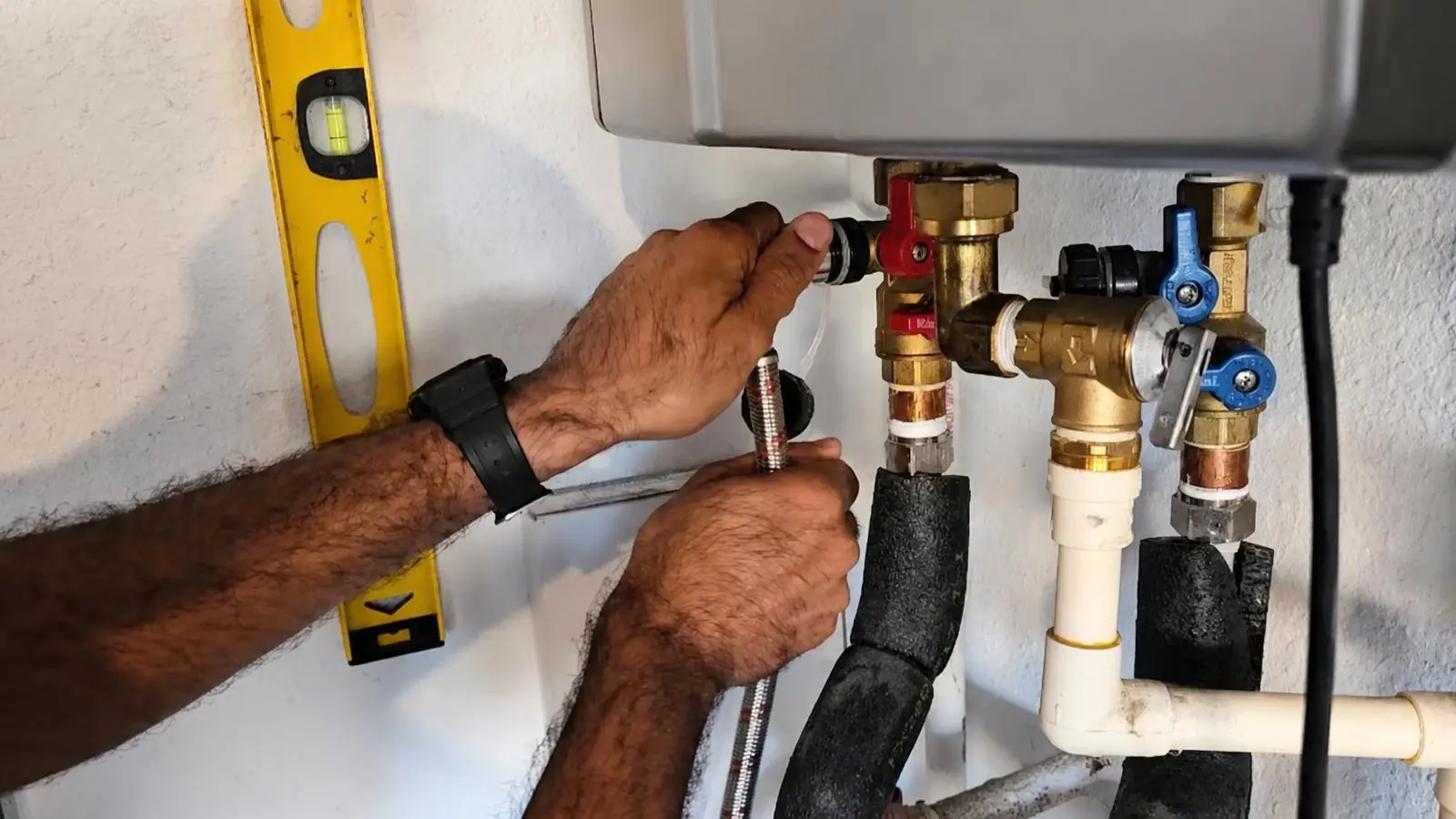
- Set and connectThe unit is mounted, piped with service valves and commissioned.
- Walk throughWe show you the display, error codes and the shutoff valves.
Source: NJ Division of Consumer Affairs, State Board of Examiners of Master Plumbers FAQ, njconsumeraffairs.gov/plu/Pages/FAQ.aspx
Gas line and venting upgrades
Most gas tankless units draw far more gas for a short burst than a tank burner does. A line that served a tank for years may be too small for the new demand, so the pipe size and run length need checking.
Venting is the other big variable. Manufacturers specify the vent material and the allowed length, and the unit exhausts hot, acidic condensate that needs a drain. If you smell gas at any time, leave the building and call the gas utility or 911 before anything else.
Electric tankless and the amperage question
An electric tankless heater skips the gas and vent, but it pulls a heavy electrical load. Whole-house models often need several dedicated breakers and heavy-gauge wire, and a small panel may not have the capacity.
An electrician may need to be involved to check the service size. We spec the unit and plumbing, and we will tell you plainly if the panel looks like the limit. Compare with water heater replacement if a tank swap is simpler for you.
Flushing and descaling a tankless heater
Minerals in the water build up inside the heat exchanger over time. Scale reduces flow, makes the unit work harder and can trigger error codes. A flush circulates a descaling solution, often white vinegar or a manufacturer-approved product, through the unit to dissolve it.
How often depends on your water and on the manufacturer's manual, so follow that schedule. To judge your water, ask your utility for its latest water quality report, or buy a test strip and check a tap. North Brunswick's 2022 report lists hardness of 67.5 ppm, which is on the softer side, but your own supplier may differ.
Source: North Brunswick Township water quality report, 2022 data
No hot water, error codes and the cold sandwich
| Symptom | Common cause | First thing to try |
|---|---|---|
| Error code on display | Scale, vent block or sensor fault | Look the code up in the manual, then call |
| No hot water at all | No gas, tripped breaker or ignition fault | Check the gas valve and breaker |
| Hot, then cold, then hot | Cold water left in pipes between uses | Wait a few seconds, then ask about a recirculation setup |
| Lukewarm output | Flow too high or scaled exchanger | Lower the flow at one fixture and compare |
The brief cold burst between two hot ones is often called a cold water sandwich. It is a design trait of on-demand heating, not always a fault. If a unit is still short of hot water after the basic checks, see water heater repair.
Cost factors for a tankless installation
Homeowners policies often cover sudden water damage but not wear or planned upgrades, so ask your insurer if you are replacing a failed unit. We give a clear price before work starts, and you can get a real number by phone once we know your setup.
Planning from Edison to East Brunswick
We serve New Brunswick and nearby towns, including Edison and East Brunswick. Same-day appointments are offered when available for survey calls.
Frequently asked questions
Permit rules vary by municipality and by what is changed, such as gas piping or venting. Ask the New Brunswick building department whether your job needs one.
After a short call or visit about your fuel, vent and fixtures, we tell you the price before any work starts.
Follow the manufacturer's manual, since it depends on your water and the model.
Often, but gas, vent and wall space need checking. It is not always a like-for-like swap.
Scale, a blocked vent or a sensor issue are common. Check the manual's code list, then call if it persists.
It can fall short if too many fixtures run at once. Sizing by flow rate avoids most of that.
Yes, call with the brand and the symptom.