
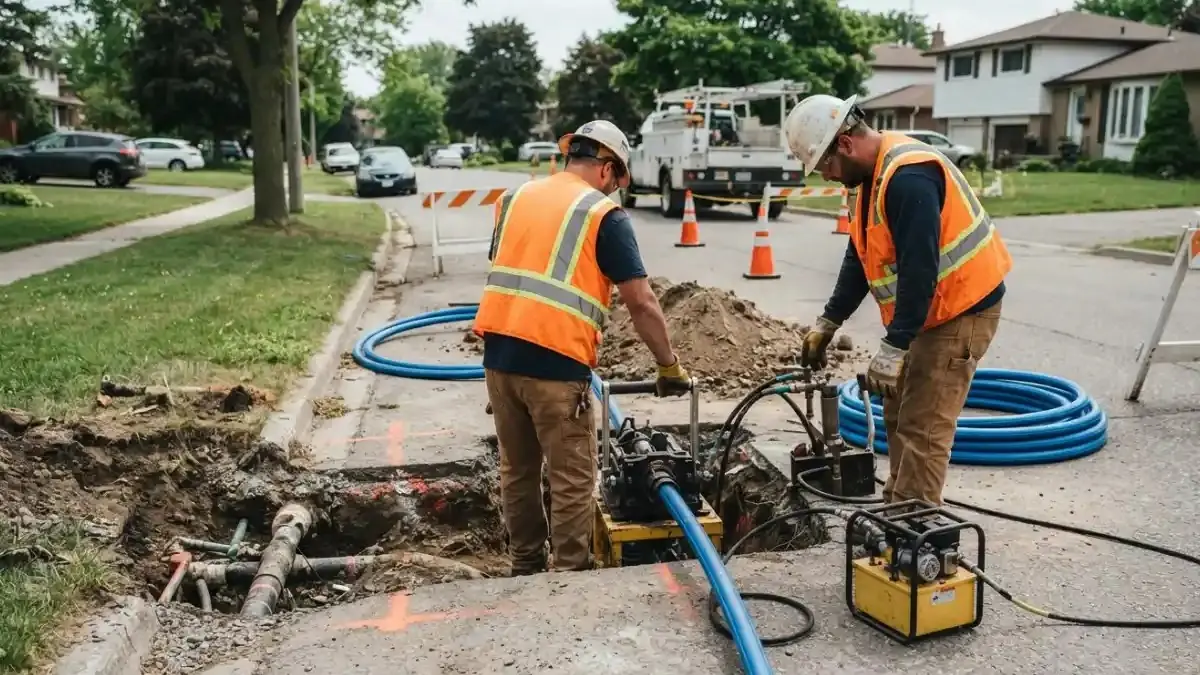
No water now, or a yard flooding from a broken line
A broken service line cannot wait for business hours, and our dispatch is open 24/7. Water surfacing in the yard or taps running dry are the usual signs. What you do in the next few minutes decides how much ground and basement gets wet.
Find the main shutoff inside the house, usually near where the pipe enters, and turn it clockwise. If water keeps surfacing outside afterward, the break is on the street side of that valve. Tell the dispatcher so the visit is planned around it.
- Shut the main valve inside and open a low tap to drain the lines.
- Keep people and pets off soft, wet ground near the break. The soil may be undermined.
- If water is entering a basement near the electrical panel, stay clear and cut power only from a dry spot.
- Read the meter. If the dial moves with every tap closed, water is escaping somewhere.
- Do not dig around the pipe yourself. Other buried utility lines may be close.
Signs the line from the street has failed
| What you notice | What it often means | First step |
|---|---|---|
| Soggy patch with no rain | A leak in the buried line | Shut main, call us |
| Meter spins, all taps closed | A leak before or after the meter | Note the reading, call |
| No water at any fixture | A break, or an outage on your street | Ask neighbors, then call |
| Pressure faded over weeks | A partial blockage or small leak | Book a visit |
| Running water sound at night | A leak under the floor or yard | Shut main, call |
No water, or a wet patch that keeps growing? Call and tell the dispatcher where it shows up.
(732) 466-1098Who owns which stretch of pipe
The service line has two parts. One runs from the water main to the curb or meter, and the other runs from there into your house. Who owns and repairs each part depends on the utility and local rules, and we do not guess at it.
Ask your water utility where its responsibility ends and yours begins, and keep your account number handy. If the break is on their side, they handle it. If it is on yours, call us and we will price the repair. We also serve nearby towns, including East Brunswick.
Dig or trenchless: two ways to replace a line
Open trench
The soil is opened along the pipe, the damaged run is cut out and new pipe goes in. It is direct and lets us see the pipe, but it disturbs lawn, walks and driveways.
Trenchless
New pipe is pulled or pushed along the old path from small access pits. Less restoration, though it does not suit every soil or every pipe condition.
Spot repair
If only one short section failed and the rest is sound, a local fix can be enough. A locator survey or camera helps decide.
The choice depends on depth, what sits above the pipe and what the old pipe is made of. We explain it on site before you commit.
Low water pressure: the street line or the house?
Weak pressure is the most common call that is not a full break. If every tap is weak, look at the supply side. If one tap or the hot side only is weak, look inside the house first.
Check that the main valve is fully open, since a half-closed valve after earlier work is an easy miss. Then compare the cold kitchen tap with a tub spout. Low everywhere points toward the service line, a partly closed valve or a stuck pressure regulator if the house has one.
- Weak at every fixture and the meter is still: ask the utility about pressure on your street.
- Weak at every fixture and the meter moves: suspect a leak.
- Weak on hot only: look at the heater and its valves, not the street line.
How a water line repair runs
- Locate the breakWe read the meter and trace the pipe. Listening gear helps when the leak is buried and nothing shows on the surface.
- Agree the planWe explain which stretch failed, whether it is yours to repair and whether digging or a trenchless route fits. You get a clear price before work starts.
- Sort out digging rulesAsk your utility and the building department what is required before any excavation. We handle the steps that fall to the plumber.
- Replace the damaged runThe failed section is replaced with new pipe and fittings suited to the connection at the meter and at the house.
- Test and restoreWe check pressure, look for weeping joints, then close the excavation and tidy the area.
Older lines, lead questions and water chemistry
We have no verified inventory of lead or galvanized service lines for New Brunswick. If your house is old, ask your water utility what material your service line is made of. That answer matters before any replacement is priced.
Water chemistry affects pipe wear. The North Brunswick 2022 water quality report lists a pH of 6.41, slightly under the 6.5 to 8.5 range it cites as recommended, and lead results well under the action level. Acidic water can be harder on older copper and galvanized pipe, so a lead result at the tap does not tell you what the buried line is made of.
If you are in Piscataway or another nearby town, check which utility serves your street before you compare reports.
According to the New Jersey Department of Environmental Protection, the state lead service line law took effect on July 22, 2021 and calls for all lead lines to be removed by July 2031. Water systems must replace the full line from the main to the building inlet, whether the utility or the owner holds it. Ask your utility what your line is made of.
Source: Township of North Brunswick 2022 water quality report, issued June 2023. | Source: NJ Department of Environmental Protection, lead service line replacement law webinar, nj.gov/dep/watersupply/pdf/njdep-lslr-law-webinar-presentation.pdf
What shapes the cost of a water line repair
On insurance, homeowners policies often cover sudden pipe failure but not wear, and the buried line may be treated differently. Ask your insurer before you assume either way.
We do not post prices because no two lines are alike. Call (732) 466-1098, tell us what you see, and we will give you a real number by phone before any work starts.
Frequently asked questions
Yes. Dispatch runs 24/7, and a main line that breaks on a holiday weekend gets the same attention as one on a Tuesday. We offer same-day appointments when available.
Close the main valve and call. Tell us whether water is surfacing outside.
Close every tap and look at the meter. A moving dial means water is going somewhere. A wet patch or sunken spot in the yard with no rain makes an outdoor leak more likely.
That depends on the utility and local rules, so ask your water utility where its pipe ends. Once you know, we can price the part that is yours.
We can replace a service line. Ask your water utility what your line is made of and what rules apply to replacing it, since we do not state those from memory.
Not always. Trenchless methods and spot repairs can reduce digging, but they do not suit every site. We explain the options once we know where the break is.
Irrigation lines are a separate system, though a leak at the connection can look the same. Describe it on the call and we will say what we can do.